Share this article
The Great Business Reset: 10 Business Shifts That Could Reshape the World in 2027–2028
What if the biggest threat to your business over the next two years is not your competitor, but a competitor operating with a completely different business model?
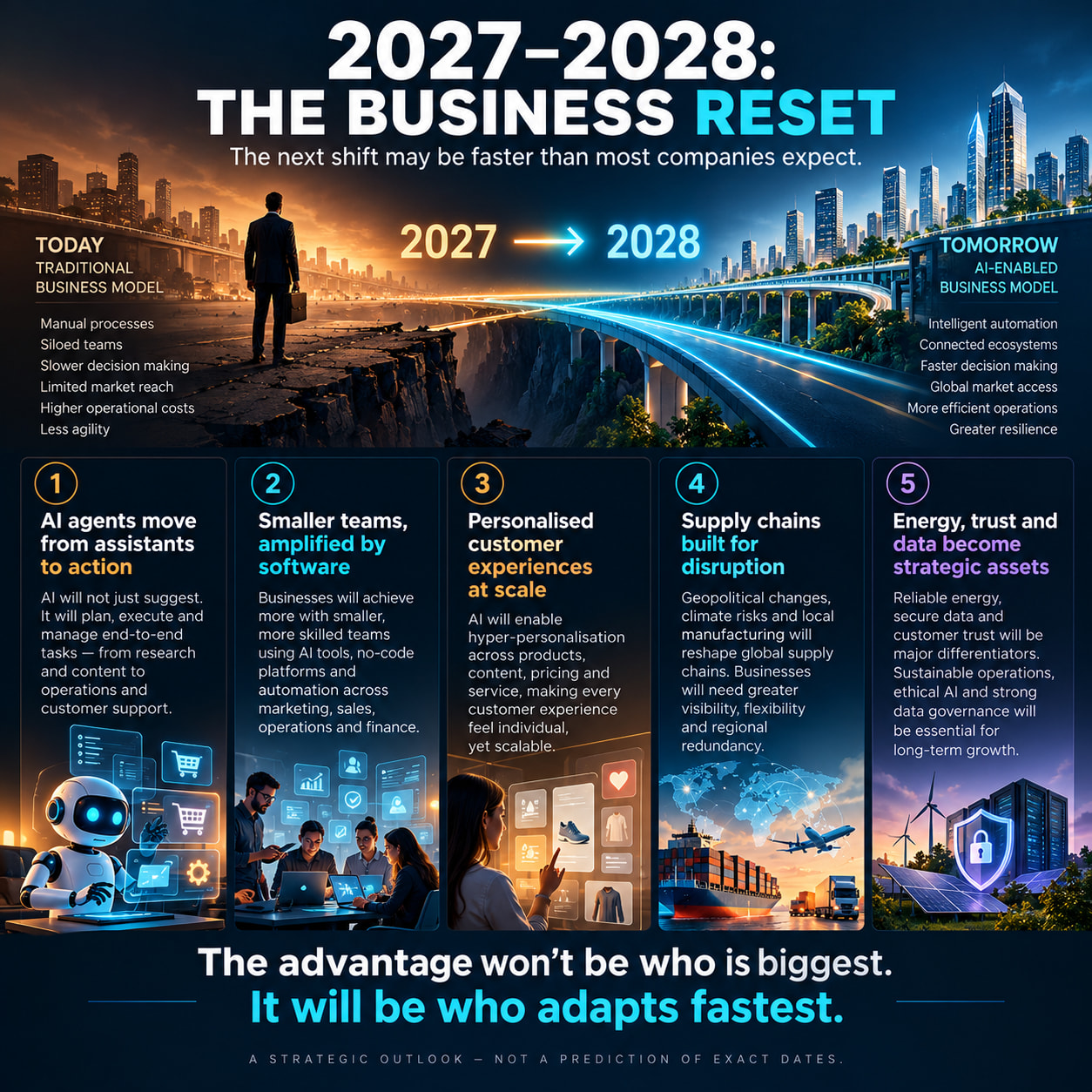
The years 2027 and 2028 could represent an important period of transformation for businesses worldwide. Artificial intelligence, automation, digital commerce, global uncertainty and changing customer expectations are converging to reshape how companies operate and compete.
These are not predictions that everything will change overnight. They are strategic possibilities grounded in trends already visible today. Businesses that prepare early may be better positioned to take advantage of the opportunities ahead.
1. AI Will Move From Assistance to Execution
Today, businesses use artificial intelligence to generate content, analyse information, write code and support customer service. The next phase will increasingly involve AI agents that can perform defined tasks across connected business systems.
In sales, AI could help qualify leads, prepare proposals, schedule follow-ups and update customer relationship management systems. In ecommerce, it could identify incomplete product listings, flag inventory discrepancies and recommend corrective actions.
The opportunity is not simply to add AI tools. It is to redesign workflows so that technology produces measurable business value. Sensitive decisions, financial approvals and important customer commitments will still need appropriate controls and human oversight.
2. Smaller Teams Could Compete With Larger Organisations
Cloud software, automation and AI are reducing the cost of accessing capabilities that previously required substantial teams. A small business can now use digital tools for marketing, design, analytics, accounting and customer management.
As these tools improve, skilled employees may be able to manage more complex workflows without a corresponding increase in headcount. This does not mean that people will become unnecessary. Human judgement, creativity, leadership and accountability will remain essential.
Business takeaway: Measure productivity, quality and customer outcomes—not just the number of employees or tools deployed.
3. Distribution Could Become More Valuable Than Physical Expansion
Digital marketplaces, direct-to-consumer websites, social commerce and quick-commerce platforms are creating new routes to customers. An Indian brand can explore demand across cities and regions without opening a physical store in every market.
However, online visibility does not guarantee profitable growth. Product quality, pricing, content, fulfilment, customer service and marketplace economics all matter.
Business takeaway: Choose distribution channels based on customer demand, margins and operational readiness rather than simply maximising the number of platforms.
4. The Gap Between Digital Leaders and Laggards Could Widen
Technology creates value when it solves real problems. A business can invest in sophisticated software and still struggle if its data is fragmented, its departments are disconnected or its processes are poorly defined.
Companies that combine reliable data, clear workflows and disciplined execution may be able to make faster decisions and improve their operations more consistently.
Business takeaway: Before purchasing another technology platform, define the problem, the required integrations and the metrics that will demonstrate success.
5. Customer Experience Will Become More Personal
AI can help businesses deliver more relevant product recommendations, personalised communication and faster responses. Retailers can improve product discovery, while B2B companies can tailor proposals to a customer's needs.
Personalisation must still respect privacy and customer preferences. Incorrect automated responses or intrusive use of customer data can undermine trust.
Business takeaway: Combine useful personalisation with transparency, responsible data practices and access to human support.
6. Business Models Could Change Faster Than Products
Software subscriptions, AI-enabled services, direct-to-consumer sales and recurring digital services are changing how businesses create and capture value. Companies that once delivered one-time services may explore recurring offerings, analytics or technology-supported solutions.
Recurring revenue is not automatically better. Customer retention, service costs, differentiation and profitability still determine whether a model is sustainable.
Business takeaway: Review not only what you sell, but how customers buy, experience and continue to value your offering.
7. Supply Chains Will Need Greater Visibility and Flexibility
Geopolitical uncertainty, changing trade policies, climate-related risks and fluctuations in transportation costs make supply-chain resilience increasingly important.
Better demand forecasting, inventory visibility and supplier diversification can help businesses respond to disruptions. The right approach depends on the cost of disruption, product lead times and working-capital requirements.
Business takeaway: Improve supply-chain data visibility and build contingency plans around the risks that could cause the greatest commercial damage.
8. The Workforce Will Be Redefined
AI will automate some tasks, change others and create demand for new capabilities. The impact will differ across occupations and industries, so neither widespread job replacement nor unchanged employment patterns should be assumed.
Employees will increasingly need digital literacy, analytical thinking, problem-solving and the ability to review AI-generated work. Businesses will need to invest in training as well as technology.
Business takeaway: Make reskilling part of your technology strategy and help employees learn how to deliver better outcomes with new tools.
9. Data, Cybersecurity and Trust Will Become Strategic Assets
Connected systems and automated decisions increase the importance of accurate data, secure access and clear accountability. Poor data can lead to incorrect inventory decisions, while weak security controls can expose customer information.
Companies deploying AI should establish appropriate permissions, audit trails, security practices and human oversight. Trust is an operational requirement, not just a marketing message.
Business takeaway: Build security, privacy and data governance into the design of your business systems.
10. India Could Create a New Generation of Technology-Enabled Brands
Indian entrepreneurs have an opportunity to combine local product knowledge with digital distribution and modern business tools. Brands from cities such as Ludhiana, Jaipur, Surat and Ahmedabad can pursue customers beyond their traditional geographic markets.
Success will still depend on product differentiation, financial discipline, reliable fulfilment and customer trust. Digital distribution creates access, but sustainable growth requires strong execution.
Business takeaway: Use technology to extend your reach and improve operations while keeping product quality and customer value at the centre.
What Should Business Leaders Do Before 2028?
- Audit business processes: Identify repetitive work, avoidable errors and slow approvals.
- Choose high-value AI use cases: Start with specific problems and measurable targets.
- Connect your data: Improve the quality of customer, product, inventory and sales information.
- Train your team: Help employees use technology responsibly and review its output.
- Review distribution: Evaluate channels by customer fit, profitability and operational readiness.
- Measure outcomes: Track conversion, response time, order accuracy, retention and contribution margin.
- Protect trust: Establish sensible controls for customer data, security and automated decisions.
The Zaroori Retail Perspective
At Zaroori Retail, we work at the intersection of brands, digital marketplaces and ecommerce operations. We believe sustainable digital growth requires more than getting a brand listed on a platform. Strong catalogues, accurate information, operational discipline, performance analysis and continuous improvement all matter.
For Indian brands, digital commerce can open new routes to customers. The opportunity is to combine that access with better execution, responsible technology and sustainable business economics.
Conclusion: The Future Will Reward Adaptability
The years 2027 and 2028 will not transform every industry at the same speed, and not every prediction about AI or automation will come true. But businesses can prepare by understanding their customers, improving operations, investing in people and adopting technology where it creates real value.
The biggest competitive advantage may not belong to the largest organisation or the business with the biggest technology budget. It may belong to the organisation that learns faster, executes better and adapts without losing sight of what customers value.
If your industry changes faster than expected, will your business be ready to change with it?
Explore how Zaroori Retail helps brands navigate digital marketplaces and build stronger ecommerce operations.
References and Further Reading
- World Economic Forum: Future of Jobs Report 2025
- McKinsey: The State of AI
- UN Trade and Development: E-commerce and the Digital Economy
Editorial note: The 2027–2028 scenarios in this article are strategic outlooks, not guarantees of events occurring in those exact years.
Share this article
Related Services
Recommended Next Reading
Stay Updated
Get marketplace tips in your inbox

About the Author
Deepinder Ahluwalia
Founder & CEO – Zaroori Retail
Deepinder Ahluwalia is the Founder & CEO of Zaroori Retail, India's leading marketplace onboarding agency. With over 8 years of experience in e-commerce and marketplace management, he has helped 4200+ brands successfully launch on Myntra, Nykaa, Ajio, and 30+ premium platforms. An IIM Lucknow alumnus, Deepinder is recognized as a thought leader in the Indian e-commerce ecosystem.
Areas of Expertise

